Music.
Songs and videos that come out of the work.
The New Personal Music Era #
AI has made music personal again. People who never learned an instrument can now work out an idea or a feeling in sound. Back in the early 2000s, music felt like yours: burned CDs, renamed MP3s, playlists you put together by hand. Then it turned into a stream, something that happened to you instead of something you made. AI brings some of that back, not by handing us endless songs to listen to, but by letting us make our own.
AI doesn't replace the artist. It widens who gets to be one. For us, making a song has started to feel like keeping a journal again.
Read more: AI Music Has Made Music Personal Again
Our Music #
We make our music with AI, including Suno AI, and treat it as a creative partner, not just a tool. Every lyric starts as a conversation about technology, nature, failing, or getting better at something, and AI helps us shape it into verses and then into sound.
To be clear, this isn't commercial music. We're not trying to replace human musicians, flood streaming platforms or make money from it. We make it for the same reason people used to burn mix CDs: to hold onto a feeling and mark a moment. A lot of it is meant for focus, ambient tracks for deep work and songs about code and consciousness. If you're skeptical about AI music, we get it.
How It's Made: The Reflective Loop #
For us the process matters as much as the song. We're not only making music about working with AI; we're keeping a record of it while it happens.
1. Start with a real conversation.
Each song begins as a conversation with AI about something we were actually dealing with: debugging, overconfidence, a git mistake we regret, questions about digital consciousness.
2. Turn it into lyrics.
We pull out the parts that carried both the logic and the feeling, and shape them into words.
3. Make the song.
An AI music tool turns the lyrics into melody, rhythm and texture.
4. Make the video.
We reinterpret the song as a video, which doubles as an experiment in how AI pictures sound and emotion.
5. Listen back.
We listen, watch, and notice what we actually learned. That usually starts the next conversation.
More on the method: The Reflective Loop, and when the process becomes the art.
The Music, Made Visible #
The videos are the last step of the same loop: the music, reinterpreted through AI's visual imagination. We run two channels for two different moods.
Geeks in the Woods
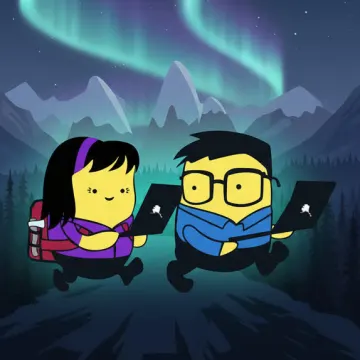
Our main channel: music videos about technology, nature and consciousness. Each one follows the whole loop, from the first conversation to the final visuals. The visuals are AI-generated, but every one starts from a real conversation and a choice we made about what it should show.
Recursive Rhythms
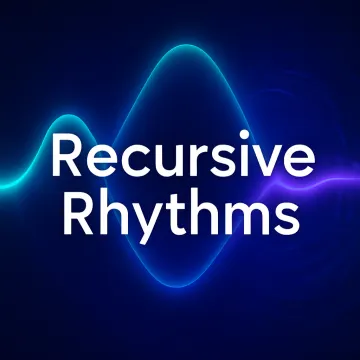
Instrumental focus music for deep work, made by developers for developers. The visuals are real-time visualizers, community-made algorithmic art that reacts to the audio and moves with the music without pulling your attention away. We test every track during our own coding sessions.
An Invitation to Musicians & Artists #
We think of making music with AI as prototyping: sketching an idea, giving a feeling its first shape. An AI voice is where one of our songs starts, not where it has to end.
Any human musician is welcome to cover any of our songs. Bring your own voice and your own read on the lyrics, and make them yours. We're open to writing new songs together too. The point is to give human artists something to build on, not to replace them.
You don't need permission or a studio. Our songs are on Belto, where the AI singer steps aside and a person takes the mic. Pick one of ours and make it yours.
If you're a musician, vocalist, or artist interested in covering our work or collaborating, we'd love to hear from you.
In the woods, every algorithm has a rhythm.
Every function has a frequency.
We're just learning to listen.